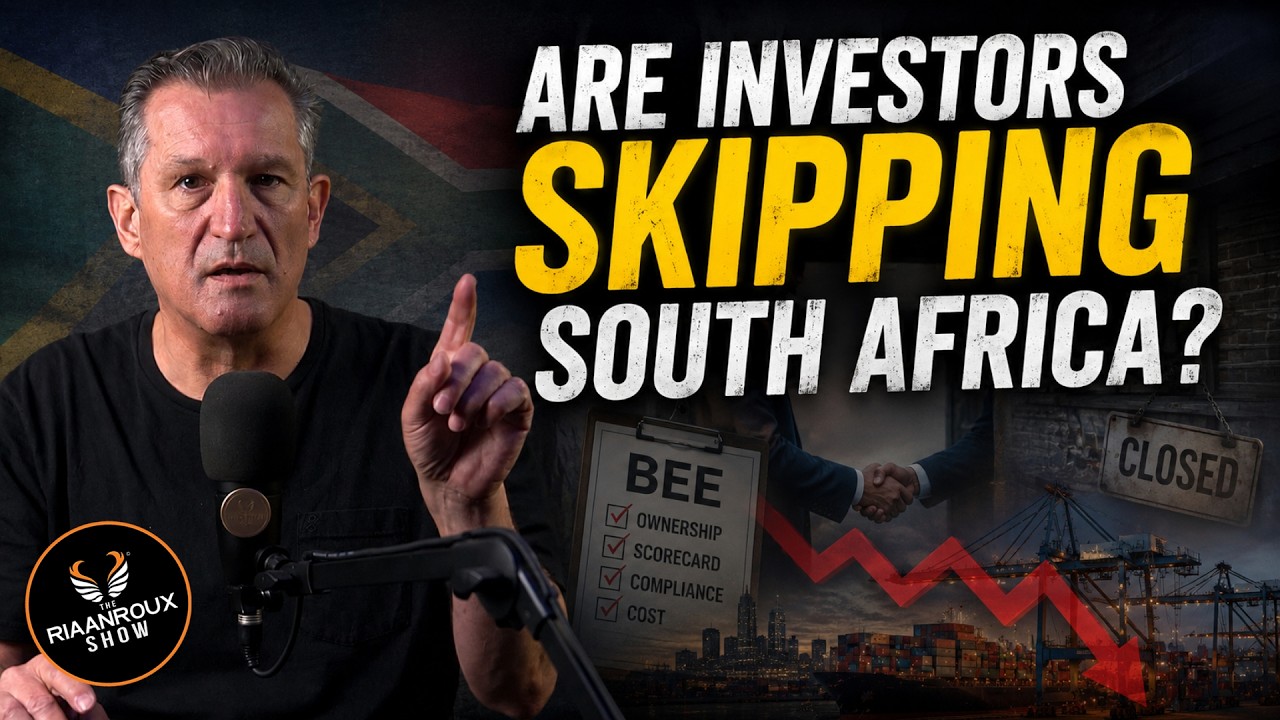
Amazon’s 100% Rule: The Law Never Asked For It
Amazon runs a business development programme in South Africa that only admits companies which are 100% black-owned, and it has told Solidarity that South African law required this of it. I read the law Amazon named, all 89 pages of it, and the requirement is not there. The only black-ownership figure that rule book puts on who may benefit from a development programme is 51%. Government’s own guidelines say the company writes its own proposal, a committee negotiates it, and a Minister approves it.
What the programme is
South African law says companies operating here must hand a share of ownership to black South Africans. That system was designed by the ANC. Some big international companies will not sell shares in their local operations anywhere in the world, so the ANC wrote them a way around it. Instead of selling shares, the company runs an approved programme that helps black-owned businesses, and government counts it as though shares had been sold. It is called an Equity Equivalent programme, and if you go looking for this story anywhere else, that is the name you will see.
Amazon Web Services launched its version in 2019. Newsday reports it formed part of a R365 million investment. The programme runs for 18 to 24 months and gives small black-owned IT companies funding, training, certification support and a route into Amazon’s partner network. Amazon received its Level 1 empowerment rating in March 2020. By its own figures, 47 companies have been through the programme since.
To be accepted, an applicant must be 100% black-owned. Amazon’s own application page attributes that requirement to the ICT Sector Code.
What the ICT Sector Code actually says
The Amended B-BBEE ICT Sector Code was published in Government Gazette 40407 on 7 November 2016 and signed by Rob Davies, then Minister of Trade and Industry.
The part of that code dealing with programmes like Amazon’s is Statement AICT103, which begins on page 41 and runs to page 43. It covers 2 things. It sets the size of the investment, either 25% of the value of the company’s South African operations or 4% of its local revenue each year. And it sets out how the programme gets approved.
On who may be admitted to the programme, the code is silent. There is no race requirement in it. There is no ownership percentage of any kind attached to the businesses that receive the help.
Twenty pages further into the same code, at paragraph 4.8 on page 61, the rule book does put a black-ownership figure on who may benefit from a business development programme. It reads that beneficiaries of supplier development and enterprise development are small businesses which are at least 51% black owned, or at least 51% black women owned.
The same figure appears earlier, at paragraph 4.3(d) on page 60, where a company earns recognition partly by spending at least 12 days a year assisting small businesses that are at least 51% black owned.
So the threshold exists. Government wrote it into the code. It set it at 51%, and it never applied it to Equity Equivalent programmes at all.
Where 100% does appear in that code in relation to ownership, it works as a reward rather than a barrier. A small business that is fully black-owned is lifted to Level 1. At 51% it goes to Level 2. Anything below that still sits at Level 4. Nobody is excluded. The same pattern appears in the Legal Sector Code published in September 2024, where full black ownership lifts an exempt firm to Level 1, 51% gives Level 2, and every other firm meeting the revenue threshold still qualifies at Level 4.
I am not a lawyer. This is my own reading of the gazette, and if there is a clause in the ICT Sector Code that requires 100% I want someone qualified to send it to me and I will correct it publicly. But if it takes a law degree to establish whether a rule exists, ordinary business owners have no way of knowing where they stand, and that is a problem in itself.
One reference that leads out of the document
Paragraph 4.3 of Statement AICT103 says the ownership score under an Equity Equivalent programme must be calculated in terms of Annexure 103(A). That annexure is not printed in the ICT Sector Code. A line at the end of the statement says it is contained in another gazette, which the text gives as Government Gazette 38766 of 6 May 2015, the Amended Codes of Good Practice.
What that annexure governs is arithmetic. It converts the money the company spends into ownership points the company earns. It is about Amazon’s score, not about who Amazon admits. The code goes to the trouble of specifying a calculation method down to a borrowed annexure from another gazette, and still never specifies who may benefit.
Who chose 100%
The Department of Trade, Industry and Competition publishes guidelines for approving these programmes, and they answer the question directly.
The guidelines state that a proposal has to be developed by the international company itself and submitted to the department. Amazon was not handed this rule. Amazon wrote it.
The department then lists what it looks for before approving a programme. There are 5 criteria. Whether the programme is commercially viable and sustainable in the long term. Whether it aligns with the overall objectives of empowerment. Whether it transfers accredited business or technical skills. Whether it can be measured against the value of the company’s local operations. Whether the country gains something beyond the company’s normal business.
Not one of those criteria concerns who may own the businesses that benefit. There is no ownership percentage in them at all. What the guidelines do state as a principle is that the programme must be broad based in its impact on the black population and the South African economy, which sits awkwardly beside a rule that turns away a black owner at 99%.
From there the proposal goes to an Equity Equivalent Committee, which meets monthly. Its permanent members are the B-BBEE Unit within the department, the National Industrial Participation Secretariat, and the Industrial Development Corporation, with a sector representative and a representative of the relevant line ministry brought in as required. The department describes that committee’s role as evaluating and negotiating proposals against the set criteria, and recommending approval or rejection to the Minister.
Negotiating. Government sat across a table from Amazon and worked through this programme.
The ICT Sector Code sets out its own route as well, running from the B-BBEE ICT Sector Council to the line ministry and then to the trade department, with the Minister approving in consultation with both. Which route the AWS programme took is a fair question for the department. Either way it ends with a Minister.
Before approval is granted and before any points are awarded, the company and the department conclude a Memorandum of Agreement, and the company reports back to the department under that agreement. So a signed agreement covering this programme exists, and 6 years of monitoring reports exist with it.
What Amazon said when asked
Newsday put the race exclusion to Amazon and reports that Amazon did not answer the question.
An Amazon spokesperson told the publication that South Africa’s B-BBEE Act is legislation every company operating in the country must comply with. The spokesperson added that the programme does not limit who Amazon can engage with, and that any business in South Africa can work with AWS.
That second statement answers a question nobody put to Amazon. Amazon does not refuse to sell cloud services to white-owned companies, and no one has claimed it does. Any business can open an account. The question was who is permitted into the development programme, and that question went unanswered.
There is an explanation available to Amazon that it has not used. The empowerment framework is genuinely complicated, and there is a real place in it where 100% black ownership matters, since a fully black-owned small business rates a level higher than one at 51%. A person reading across those provisions could conclude that the highest figure produces the best outcome and apply it as an entry requirement. That would be a mistake rather than a policy.
Amazon could have said that. It would have been believable. It said the law required it instead.
Who else the rule locks out
The 100% requirement does not only exclude white-owned businesses.
A black founder who gave a white investor 5% of his company in exchange for start-up capital is excluded. A black founder who sold a small share to raise money and grow is excluded. A black founder who set up a scheme allowing staff to own part of the business is excluded if any of those staff members are white.
The programme helps the founder who stayed small and kept every share to himself, and shuts the door on the one who brought in outside money and built something bigger. That is backwards on the policy’s own terms.
It also places a black owner in a difficult position. If he needs the support, the only route in is a document stating that he owns every single share. The temptation is to conceal the white shareholder and sign the form anyway. There is a word for that in this country. It is fronting, and it is a criminal offence.
Amazon’s best argument
Amazon has an argument here and it deserves to be put properly.
Ownership in the South African IT sector remains heavily skewed. Set the bar at 51% and a substantial portion of the money flows to businesses that already have white capital inside them, while founders with no capital at all are passed over again. Setting the bar at 100% ensures the support reaches people who own nothing else.
The difficulty is that Amazon’s own rules already achieve that. Applicants must be small businesses turning over between R500,000 and R50 million a year. A turnover limit is what identifies small founders. The 100% requirement on top of it does not reach anyone new. It removes the black founder who succeeded in raising money, who is arguably the founder the programme should be proudest of.
Why this became a story in 2026
None of this was concealed. Amazon published the entry rules on its own website, announced each intake, and the technology press carried applications-open reports in 2022 and again in 2024. The requirement sat in the open for 6 years.
What changed in 2026 was Washington.
In March 2026 the American ambassador to South Africa, Brent Bozell, spoke at the BizNews Conference in Hermanus and set out 5 things the United States wants from this country. Two of them bear on this story. One is that American companies be allowed to compete in South Africa on an equal footing. Another is an end to companies being required to hand over ownership or control of their own decision-making as a condition of doing business here, and Bozell named empowerment legislation when he said it. He said those requests had been with the South African government for nearly a year without a substantive response.
In the same speech Bozell held Amazon up as an example of what American investment brings to South Africa, and pointed to the AWS Skills Centre in Cape Town as the first Amazon built outside the United States.
On 26 March 2026 President Trump signed Executive Order 14398, titled Addressing DEI Discrimination by Federal Contractors. Section 2 of that order defines what it prohibits as treating people differently by race in recruitment, employment, contracting, programme participation, or the allocation of an entity’s resources. It then defines programme participation as admission to a training, mentoring or leadership development programme sponsored or established by the contractor.
Amazon Web Services is an American federal contractor. The programme it runs in South Africa provides training and development, and it admits businesses by race.
The order allows a contracting agency to cancel or suspend a contractor’s work, allows the contractor to be barred from future federal contracts, and directs the Attorney General to consider action under the False Claims Act.
What the order does not obviously reach is a programme run in another country, because the clause it creates attaches to work performed under an American federal contract. That is the gap.
What Solidarity and the Freedom Front Plus have done
Solidarity announced on 2 September 2026 that it would investigate the programme, its admission requirements and possible remedies.
On 3 September 2026 Solidarity chief executive Dirk Hermann published an open letter to Amazon under a heading calling on the company to remove race from its support programme. Hermann wrote that Amazon goes further than South African legislation requires. He wrote that before anyone had opened the gazette. The documents confirm he was right.
Hermann said exclusion on the grounds of race is not diversity, and he said racial exclusion is morally unjustifiable. Responding to Amazon’s position that the law compelled it, Hermann said that does not make Solidarity wrong, it still means Solidarity is right, except for the minor detail that there is no obligation on a company to exclude 100%.
The Freedom Front Plus, through Jaco Mulder, has referred the matter to United States authorities and has written to Amazon and to the Department of Trade, Industry and Competition asking whether the 100% requirement is a direct requirement of empowerment regulations, a condition attached by government, or a decision by Amazon itself.
Mulder has been careful about what he is alleging. He said the question is whether a big international company and federal contractor applying an absolute racial requirement outside the United States sits comfortably with current American policy. He has stopped short of claiming a law was broken.
That is why an Afrikaans organisation is writing to an ambassador rather than approaching a South African court. The relationship between this government and both Solidarity and AfriForum has been strained for years, and that route has produced very little.
What it costs to build something here
Consider a young man born in 1996, into a democracy, with no connection to apartheid because there was none left when he arrived.
He builds a product over 10 years, on his own, with no staff. It works. The only buyers for what he built are governments. He turns over R15 million a year.
That figure places him above the level at which a small business is simply left alone, so he needs a proper empowerment score to win the work. He can earn points for training and for supporting other businesses. The ownership points are the ones he cannot earn at all, because there is only one way to obtain them.
Nobody arrives and takes his company. He signs the shares away himself, because the alternative is a business that can never win the work it exists to do.
He can keep every share of a company with no market, or he can move the operation to another country, which for a software business takes a few weeks. There is no count of the ones who leave. No register of the business that quietly relocated, and no line in any report for the investor who read the paperwork and went somewhere simpler. An investor does not sit down and work out a route through our rules. He goes where there is no route to work out.
When does it end
The Legal Sector Code, published in September 2024, describes black economic transformation as something other than a once-off event. It calls it a continuous incremental process that runs until all systemic barriers are removed. It complains that existing targets are only a minimum, with no provision for raising them over time.
Continuous, until all systemic barriers are removed. Nothing measures that, and nothing closes it.
Nobody in government has ever put a date on any of this, and nobody has said what would have to change for it to end. So it does not end. It moves. The disadvantage is picked up off one group and set down on another, and everyone agrees to call that transformation.
If a man’s wealth was taken from someone else, giving it back is justice. Taking from someone who never took anything is something else.
If you already have money in this country, you can still get in. You can buy a share of a business that qualifies, put money into a partnership that scores well, or pay for the qualifications that open a door. Money finds a way around rules, because it always does. If all you have is your ability to work, there is no route left. You cannot work your way to a share of a company that is closed to you, and you cannot study your way past a rule about who your parents were.
What happens next
Amazon can change that number and remain entirely within South African law, because the law never asked for it. Hermann has told the company exactly what to do and it amounts to one line in a programme guide.
The department can say whether the 100% was in the proposal Amazon submitted, or whether it was added during the negotiation its own guidelines describe. The Equity Equivalent Committee can say the same. The Memorandum of Agreement and the approved business plan would settle it, and both are held by a public body.
Documents referenced: Government Gazette 40407 of 7 November 2016 (Amended B-BBEE ICT Sector Code), Statement AICT103 at pages 41 to 43 and Code Series AICT400 paragraph 4.8 at page 61. Legal Sector Code, Government Gazette 51271 of 20 September 2024. The Department of Trade, Industry and Competition’s Equity Equivalent Programmes for Multinationals page and published guidelines. The AWS Equity Equivalent Investment Program guide. Executive Order 14398 of 26 March 2026. Reporting by Newsday and MyBroadband. Statements by Solidarity and the Freedom Front Plus, 2 and 3 September 2026.