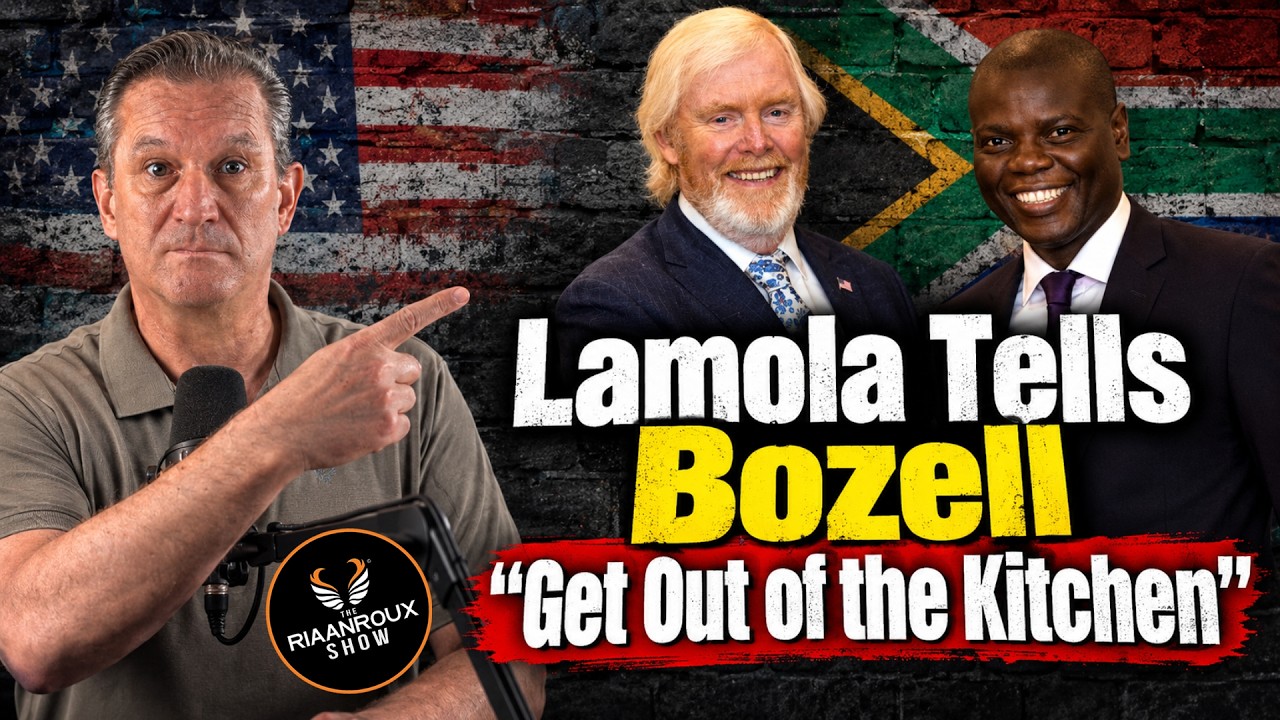
Bozell says relations have been sliding for years, and that Ramaphosa refused America’s 3 open asks
US Ambassador Leo Brent Bozell gave 2 interviews on 21 September 2026, 1 to SABC News and 1 to Business Day, 6 days after Washington announced visa restrictions aimed at South Africa. In both, he said Ramaphosa’s reply to Trump refused every 1 of the 3 asks still open, on the Kill the Boer chant, farm safety and investment rules for mining and telecoms. The Presidency disputes that the letter was a rejection, but will not release it. Neither government has ever published the 5 asks themselves.
2 interviews in 1 day
On 21 September 2026, the US Ambassador to South Africa, Leo Brent Bozell, sat down with Sophie Mokoena of SABC News and with Hajra Omarjee, political editor of Business Day. It came 6 days after the US State Department announced its visa restriction policy aimed at South Africa, and 5 days after Bozell posted on X that the policy was only the first step in a series of escalatory measures.
Before the interviews aired, Bozell posted photos from both sittings on X under the line “No ambiguity about where America stands.” Business Day has since published its full interview on YouTube, which means both conversations can now be watched in full.
To SABC, Bozell put the problem this way: “The relations have been sliding for years.” He said some people like to blame Donald Trump, but the slide started before Trump and has sped up in recent years, to the point where Washington now asks whether it has a partner in South Africa at all.
What the 5 asks are, as Bozell describes them
Neither the US government nor the ANC-led government has ever published the 5 asks. Everything the public knows about them comes from descriptions, and those descriptions have not always matched. What follows is the list as Bozell gave it on 21 September, in both interviews.
Bozell told both outlets that the asks came after Trump’s executive order on South Africa in early 2025 and a year of talks, and were handed to the government in December 2025.
The first was that the government leave the US refugee programme alone. Bozell said the government has not interfered since December and has told Washington it will not. The US counts that 1 as resolved.
The second was expropriation without compensation. Bozell said the US sees it as a threat to anyone who wants to invest in South Africa. He told SABC that the US has taken it off the table, but only on a condition. The courts are hearing a challenge to the law, and Bozell said the broad expectation is that they will find it unconstitutional. If they rule the other way, he said, the US will treat it as a warning to investors, because other countries have used this kind of law to take over companies. In his words to Business Day, “Unless that doesn’t happen, we consider that one asked and answered.”
The third was that President Ramaphosa condemn Kill the Boer, kill the farmer as an incitement to violence.
The fourth, as he described it to Business Day, was to list rural violence as a priority crime and do more about it. He said the US found 3 plans, including the police ministry’s own plan, and offered to help pay for them.
The fifth concerns a rule in the BEE system. Every sector of the economy now has an option where a big international company can pay into development programmes instead of handing over part of its shares to meet ownership targets. Mining and telecoms do not have that option. Bozell told Business Day the US finds that “an outrageous situation” given how many American investors want to put money into mining.
That leaves 2 asks the US counts as settled, 1 of them only for as long as the courts rule the way Washington expects, and 3 still open.
9 months, then a no
The order in which things happened matters to Bozell’s argument, and he laid it out in both interviews.
He told SABC that 9 months after the asks went over, South Africa still had not responded. He told Business Day it was 8 months. Either way, he said, he then went to Washington, where Trump and Secretary of State Marco Rubio told him they had run out of patience. He said the asks could have been answered in 24 hours.
Bozell told Business Day he delivered a message from Trump to Ramaphosa about 3 weeks before the interview, saying America had run out of patience and wanted answers. The answer came in a letter from Ramaphosa to Trump the week before the interviews.
Bozell told SABC that when the response came, the asks were simply ignored. To Business Day he was specific. He said Ramaphosa refused to condemn Kill the Boer, refused to do anything new to help farmers, and refused to extend the investment option to telecoms and mining.
He said the US reads this as a government that is not being helpful, and that it has now said the time for talking about these asks is over. He said harder issues will need real discussion later, but these asks were simple, and if simple issues cannot be settled, the harder ones have little chance.
The Presidency’s answer
Alistair Ruiters, special adviser to Ramaphosa, answered Bozell in the Business Day report. His central charge was that Washington keeps changing its demands, which he put as “They keep shifting the goalposts.”
Ruiters said the US had come to the government a few weeks earlier asking for commitments on critical minerals, and that the government gave them. He also said the US had asked the government to talk with a group inside South Africa, and that it has been doing so. He disputed that Ramaphosa’s letter amounted to a rejection, and pointed out that the government has committed to reviewing parts of its BEE rules.
Look at what Ruiters actually named. Both of the extra requests he described are ones he says the government met. The asks Bozell says were refused are the original ones.
On the BEE review, the 2 sides are closer than it sounds. Bozell told SABC that Ramaphosa is re-evaluating BEE, and welcomed it. But a review is a promise to look at something. The fifth ask is a specific change to a specific rule, and Bozell told SABC who stands in the way on the mining side: “it is your minister of mining who’s in the way of this.” On telecoms, he said, it is a regulation, and a regulation can be fixed.
Can anyone check the goalposts claim?
This is my view. Nobody can check the goalposts claim, in either direction. Neither government has ever published the asks in writing, so there is nothing official to show that the goalposts moved, or that they stayed where they were.
What the public can see is that the way the asks are described has changed from 1 telling to the next, Bozell’s own included. In March 2026, speaking in Hermanus, Bozell’s list included foreign policy alignment. In September 2026, Daily Maverick published a version from a diplomatic source that included showing real non-alignment by distancing South Africa from US enemies such as Iran. The list Bozell gave on 21 September has no foreign policy item at all, and includes the refugee programme instead.
The Business Day interview may explain that. Bozell said there is a second, separate list of 8 asks on foreign policy, that he believes 2 of them are resolved and 4 are on their way, and that the discussions on them have been private. Nobody outside the 2 governments has seen that list either.
Even the timing shifts. On 21 September Bozell said the asks were delivered in December 2025. Reports of his March 2026 remarks had him complaining that they were put to the government more than a year earlier.
That shows the descriptions changing. It proves nothing about what is written in the documents themselves. And the 3 asks still open, the chant, farm safety and the mining and telecoms rule, show up in every version, in one form or another.
If real negotiations are going on, both countries would be better off doing them where South Africans can see them. Put on the record what was asked and what was answered, and the public knows something is happening. Keep it behind closed doors, and all anyone has left is guessing.
The letter nobody can read
Ruiters told Business Day the Presidency will not release Ramaphosa’s letter, because it is addressed to a head of state and the Presidency is waiting for a formal response from the White House. The US has not released it either.
Letters between presidents are often kept private. Between these 2 presidents, that has not been the rule. On 7 July 2025, Trump made public his own letter to Ramaphosa announcing a 30% tariff on South African goods. The next day, the Presidency answered with a public statement on X that set out its own reading of the trade figures, the Framework Deal South Africa had sent the US on 20 May 2025, and a meeting with US officials in Luanda on 23 June 2025.
So the Presidency has told South Africans what it said to Washington before, when it suited its case. This time, it will not show them what Ramaphosa wrote.
The ANC-led government has defended itself for years by pointing to what is on paper. This time even the paper is hidden. And with the 5 asks also unpublished, South Africans are being asked to pick a side on 2 documents, with neither government willing to show its own.
Whatever the letter says, 1 of the 3 open asks can be checked by anyone. The condemnation of the chant that Washington asked for has not come from Ramaphosa.
The chant
Mokoena put the government’s position to Bozell. She said the highest court in the land had found nothing unconstitutional about the song, and asked how the president could go against that. The Constitutional Court did not rule on the song itself. It refused leave to appeal, which left the lower court’s finding in place.
Bozell said a court ruling does not stop a president from disagreeing with it, and that there is no law preventing Ramaphosa from condemning the chant. He said the US had offered a way to make it even-handed: denounce all incitement to violence, and if anything similar has been said by Boers, condemn that in the same way.
He told Business Day the US is not asking for the chant to be called hate speech, but incitement to violence, and that this should not be hard to do. He also said three quarters of South Africans see the chant as incitement, and that he has seen polling on it. He did not say which poll, so that remains his claim.
My view is this. Even if the highest court in the country found those words legal, that does not mean the rest of the world has to accept them. Anyone in any other country who reads or hears those words takes them the same way every farmer here does, as a threat.
Farm safety and the race card
Both interviewers answered the farm safety ask with the same point, that serious crime in South Africa hits black South Africans hardest, farm workers included. Bozell did not dispute that crime is terrible for everyone. His point was about rural areas with very little police presence, where farmers and private organisations have had to protect themselves.
He described a farmer who stopped him at a garage on the way back from Kruger. The man said he farms 800 hectares with 40 employees, black and white, that he had been attacked and shot at, and that every farmer now carries a gun and sleeps with one nearby.
Bozell said the US asked for rural violence to be treated as a priority crime, brought Ramaphosa 3 plans including the police ministry’s own, and offered American money to help pay for it. He said Ramaphosa’s reply gave no commitment on this.
In my view, bringing general crime into this, and folding farm attacks into the numbers for the whole black population, does 2 things. It turns farm safety into a race issue, and it waters down a real problem that rural communities live with every day. AfriForum and Solidarity have said openly that farm attacks hit black farmers and farm workers too. That is not hidden. So when the media reaches for the race card here, to me it is an attempt to divide people further, and there is no need for it.
Sovereignty was never the issue
Minister Ronald Lamola and others have described the asks as an attack on South Africa’s sovereignty. Omarjee raised sovereignty with Bozell, arguing that most South Africans support economic redress and that the US should respect South Africa’s economic policies.
Bozell answered that the fifth ask accepts BEE in full. He said there has never been a challenge to BEE, and that the ask only seeks the same investment option for mining and telecoms that every other sector already gets. He said the government has turned it into a sovereignty argument anyway, and that “there’s no assault on sovereignty there.”
On whether this is really about America wanting South Africa’s minerals, a theory Mokoena put to him, Bozell said anyone saying so knows it is not true. He was also open that the US wants some of South Africa’s minerals, and wants to compete for them on the same terms as everyone else. He said the US has billions of dollars ready to invest, and called it downright foolish that the government will not give mining and telecoms what it gives everyone else.
Look at the 3 open asks side by side. Condemn a chant that calls for killing farmers, treat rural violence as a priority with American money on the table, and give 2 sectors a rule the rest of the economy already has. None of that takes a single decision away from South Africa. To me, these are basic terms for fair dealings between 2 countries.
What Bozell actually said about Mbeki
The headline on Business Day’s report said Mbeki is the best person to break the deadlock, and other outlets followed. What the 2 interviews show is more modest.
In the SABC interview, Mbeki came up because Mokoena raised him. She asked whether Bozell’s contact with the former president could continue as a way for the 2 countries to find each other. Bozell answered with praise, calling Mbeki a wise and highly respected man, and said he had invited Mbeki to give the main speech at the embassy’s 250th Fourth of July celebration. He then said, “I would very much hope and I understand there’s consideration to be for him to participate in this process.”
That is a hope, and an idea still being weighed up. Nothing has been decided, nobody has appointed Mbeki to anything, and Ramaphosa’s own point man on this in Washington is still Roelf Meyer.
In the Business Day video, Bozell brought Mbeki up himself, as 1 example of ANC figures who want to work with the US, alongside some ANC ministers and political leaders. It was Omarjee who then asked whether bringing Mbeki in as a special envoy could find a resolution. Bozell’s answer began with “No.” Business Day’s written report quotes Bozell praising Mbeki’s grasp of diplomacy; those lines do not appear in the published video, which may not include the whole conversation.
Mbeki could not answer the 5 asks in any case. Only Ramaphosa can condemn the chant, and only his government can change the rule for mining and telecoms. What the praise does show is how Washington rates the current handling of this, and it lands harder because the man being praised is the president the ANC itself recalled from office in September 2008.
The word that keeps coming from the question
Near the end of the SABC interview, Mokoena asked Bozell whether he agrees with some Afrikaners in the US who keep saying there is a genocide in South Africa. Bozell said he cannot comment on what other people say, that he only speaks to the 5 asks, and that the word is not in them.
In the Business Day interview, the word came up 3 times, each time from Omarjee. Bozell’s reply the first time was that the ask on rural crime does not use it. When Omarjee returned to it later, pressing him on whether the claim is racist, Bozell told her she was making a political point rather than asking a question as a journalist.
Here is how that word ends up in so many reports. An interviewer puts it into a question. Whatever the answer is, even a refusal, the clip or the headline carries the word. Cut the question from the clip and it sounds as if the person being interviewed raised it. In print, the word slips into the reporter’s own description of the story, and it reads like the US position.
Check the documents. The word is not in the 5 asks as Bozell describes them. It is not in the visa restriction policy, which is about land taken without payment, rules based on race and incitement to violence. In both interviews on 21 September, Bozell only touched it when asked, and then only to turn it down.
Once the word is attached, anyone can knock it down and wave away the whole list with it. The chant, farm safety and the mining rule never get answered, because the argument has moved to a word the US did not use.
What happens now
Bozell told SABC that it is South Africa’s move, and that every step so far has been taken by the United States. He told Business Day he is not as optimistic as he once was, but still hopes a way can be found, and that he has been heard by some sectors of government, including some ANC ministers and political leaders who want to work with the US.
Lamola told Business Day, in an interview published on 17 September 2026, that the government will not surrender to US pressure on its own policies. So Washington says it is South Africa’s move, and the ANC-led government has already said it will not give in on its own policies.
Bozell had already said what comes next. His X post on 16 September called the visa restriction policy only the first step in a series of escalatory measures.
On the visa restrictions themselves, Mokoena asked whether South Africans will get a list of who is affected. Bozell said no. He said the law does not allow the names to be published, and that names are added and taken off all the time. He told Business Day that anyone not involved in pushing expropriation without compensation or racial policies has nothing to be concerned about. That means nobody outside the US State Department will know who is on the list.
Omarjee also raised the local government elections, asking whether the US had considered that failing to settle this now could leave it dealing with figures such as Jacob Zuma and Julius Malema later. Bozell called those terrible realities, and said the US is aware of them.
My view
There are 2 documents in this story that South Africans have never seen, the 5 asks and Ramaphosa’s reply. They could answer the questions everyone has, and put an end to a lot of what is being claimed.
Instead, much of the time in both interviews went to defending the ANC’s foreign policy and South Africa’s sovereignty, when sovereignty was never the issue. There was a chance to hear from the US ambassador what the problems are and how they can be fixed. It turned into weak attempts to catch him out, and all that did was divide viewers and readers further.
What matters between these 2 countries is a healthy trade and economic relationship. Getting there takes very little action, at almost no cost, on 3 asks.