AfriForum vs Matlosana: The Budget That Does Not Add Up
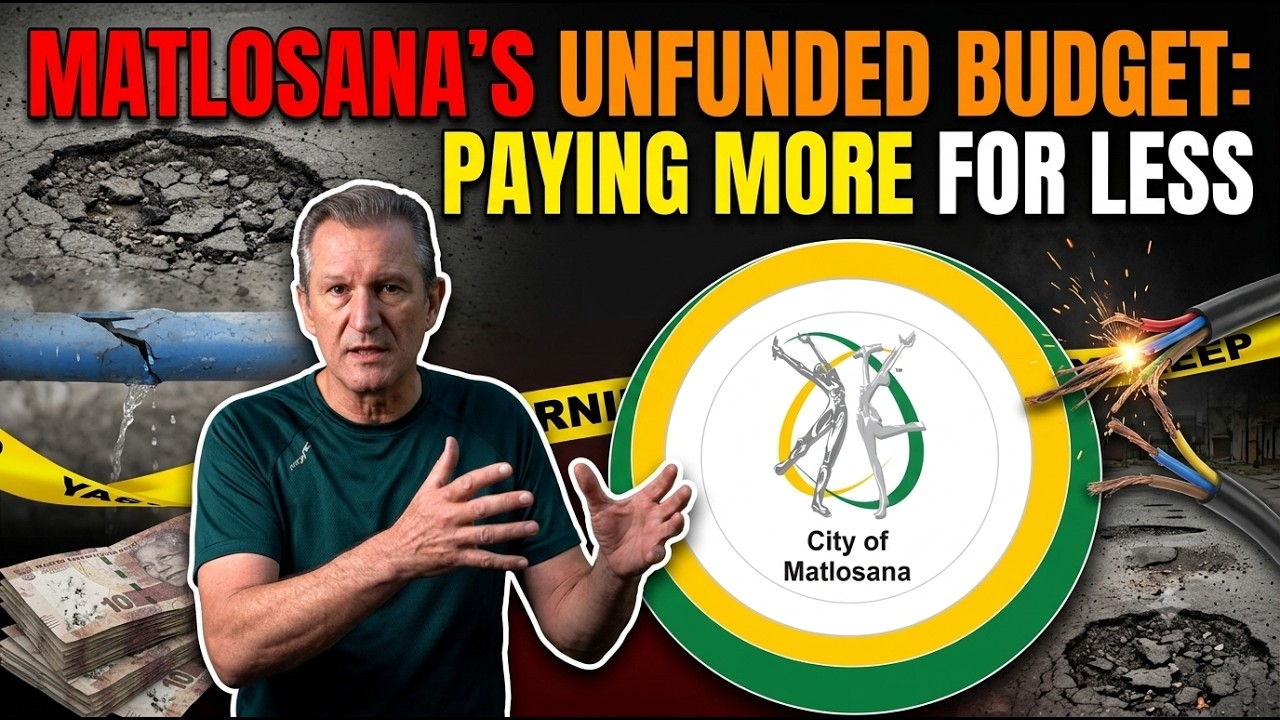
AfriForum’s Klerksdorp branch has formally challenged the City of Matlosana’s 2026/27 budget, arguing that a projected surplus of R3.95 million is built on revenue assumptions the municipality has no realistic prospect of achieving.
In a formal submission dated 13 May 2026, AfriForum’s Klerksdorp branch delivered a 28-page technical analysis to the City of Matlosana, identifying what they describe as systemic financial risks that render the municipality’s projected surplus a compliance exercise rather than a genuine recovery.
The City of Matlosana, which governs Klerksdorp and the surrounding area in the North West province, is currently under provincial intervention in terms of the Municipal Finance Management Act. The 2026/27 budget projects a turnaround from a deficit of approximately R265 million to a surplus of R3.95 million. AfriForum argues that projection is not credible.
The core of their challenge rests on the collection rate assumption underpinning the budget. The municipality assumes it will collect 70% of what it bills residents. Its actual collection rate is approximately 58%. AfriForum calculates that applying the real rate would increase the required debt impairment provision by approximately R1.47 billion, eliminating the projected surplus and replacing it with a deficit nearly 400 times larger than the surplus the budget advertises.
A second concern relates to interest income. The budget projects approximately R800.7 million in interest earned on outstanding debtor accounts, a 19.63% increase from the prior year. AfriForum’s submission notes that under the accrual accounting system municipalities use, this interest is recorded when it is charged, not when it is received. In a community where the official unemployment rate in the North West province stands at 40.1% and the expanded rate at 54.7%, the probability of recovering penalty interest from residents who cannot afford their primary accounts is, AfriForum argues, near zero.
The budget also counts on R200 million from electricity disconnections and debt collection drives. AfriForum’s submission challenges this on two grounds. First, disconnecting households with no income does not produce payment. Second, aggressive disconnections in high-unemployment communities historically drive illegal reconnections and meter bypassing, converting billed debt into unbilled distribution losses. The municipality still pays Eskom for the bulk electricity, but can no longer bill anyone for it. AfriForum argues the strategy is likely to worsen the distribution loss problem the municipality has separately identified as a challenge.
On the infrastructure side, National Treasury recommends municipalities spend approximately 8% of their operational budget on repairs and maintenance. Matlosana budgets less than 4%. Asset depreciation runs at R357.76 million per year against capital expenditure of R242.8 million, meaning R114.96 million in infrastructure value is consumed annually without replacement. AfriForum’s submission describes this as a maintenance death spiral.
AfriForum also challenged the process itself. When the budget was advertised for public comment in April 2026, the supporting documents were not available on the municipal website, at the Klerksdorp Library, or at the Office of the Speaker. AfriForum formally demanded the process be restarted from scratch, arguing that meaningful public participation cannot occur without access to the documents under discussion.
A separate letter to the Speaker raised a further concern. Council Resolution CC 87/2025 required the Executive Mayor to respond in writing to public submissions from the prior budget cycle. According to AfriForum, that response was never provided. The implementation reports show blank columns against the resolution for the April to June 2025 period, and the resolution does not appear as an outstanding item in the subsequent quarterly report at all.
The City of Matlosana has not publicly responded to the submission. The budget process is ongoing.