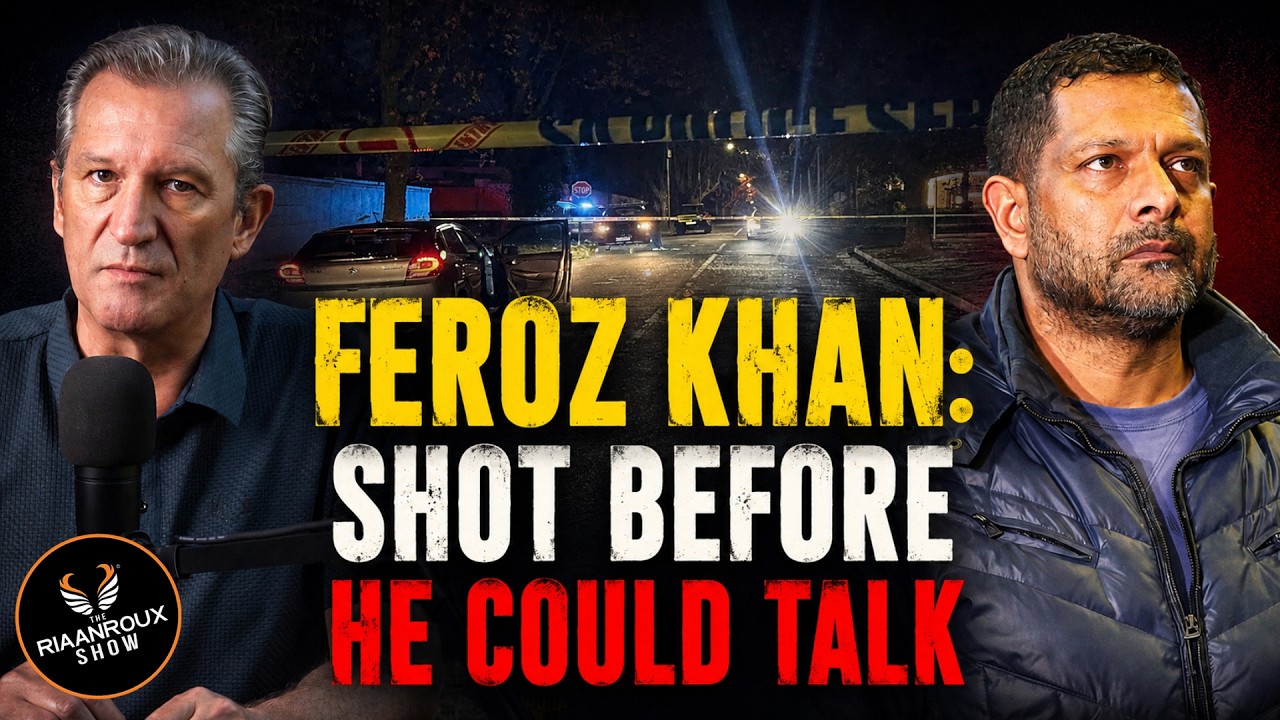
Feroz Khan Update: The Evidence Has Shifted
Details from the crime scene investigation that emerged on Monday materially change the picture of what happened on Sunday night in Houghton. The laptop was not taken by the gunmen. It was found hidden in the spare wheel compartment of Khan’s own vehicle. No bullet holes were found on the car. And a handwritten yellow note recovered at the scene calls for criminal charges to be opened against 2 serving police officers already under scrutiny by the Investigating Directorate Against Corruption.
In the immediate hours after the shooting of Major-General Feroz Khan on Sunday 28 June 2026, it was reported that his laptop and phone were taken at the scene. That account came from sources at Netcare Milpark Hospital, where Khan was rushed after being shot twice in the abdomen at approximately 11pm on 3rd Avenue in Houghton, Johannesburg. Most of South Africa was still watching Bafana take on Canada.
Details from the crime scene investigation that emerged on Monday change that account in 3 significant respects.
The laptop was not taken. It was found hidden inside the car.
The Laptop
According to the crime scene investigation report, Khan’s HP laptop was recovered from the spare wheel compartment of his grey Suzuki Baleno. The phone remains unaccounted for.
This finding materially changes the argument made in initial coverage of the shooting, including on this channel. If the gunmen took the laptop, the attack is consistent with a targeted intelligence operation aimed at destroying evidence before Wednesday’s testimony. If the laptop was hidden in the spare wheel before or during the attack, a different set of conclusions follows. A man who anticipated what was coming and concealed the device himself. A man who may have been prepared for the possibility that he would not make it to the commission on Wednesday.
Both readings remain possible. They lead to different conclusions about what happened on Sunday night, and it would be dishonest to pretend otherwise.
No Bullet Holes
The same crime scene report states that no bullet holes were found on Khan’s vehicle. 2 spent 9mm cartridges were recovered at the scene and a projectile impact was identified on the road surface. Khan sustained a genuine abdominal wound and underwent emergency surgery. The medical evidence is not in question.
The absence of bullet holes on the vehicle is one of the key pieces of physical evidence the Political Killings Task Team will be examining. If 2 shots were fired at a stationary or slow-moving vehicle at close range, and neither round struck the car, investigators will need to account for the exact sequence of events that produced that outcome.
Khan’s attorney pushed back on the staged shooting theory, arguing no sane person would take a bullet to the abdomen with vital organs in that space. That is a fair point. The wound is real. The circumstances that produced it are what investigators are working to establish.
The Handwritten Note
A handwritten yellow note was also recovered at the scene. The note called for a criminal case to be opened against Colonel Khorombi and General Dumisani Khumalo, to be investigated by IDAC.
Khumalo is the suspended head of Crime Intelligence and has a documented history of conflict with Khan. Khan previously alleged that Khumalo used the 2021 Aeroton drug bust to orchestrate his removal. IDAC is already investigating both Khorombi and Khumalo.
2 questions about this note are now the subject of the high-level police investigation. Was it planted at the scene by someone wanting to direct suspicion toward Khumalo and Khorombi? Or did it belong to Khan, a man who feared for his life and was preparing to name names before the commission?
Both are plausible. The PKTT will determine which.
There is no version of the real hit theory that does not require a leak of some kind.
How Someone Found Him
Khan’s advocate, Zubair Khan, confirmed on Monday that Khan had been deliberately rotating vehicles in the days before the shooting, travelling in unmarked cars specifically to avoid being tracked.
Despite those precautions, 2 men in a white Mercedes-Benz found him at 11pm on a Sunday night, on a specific street, in the correct vehicle. Either someone who knew his movements communicated that information to the gunmen, or Khan was at a location he had shared with someone he trusted. Both possibilities lead to the same question: who knew where he would be?
The Compromise Concern
Advocate Zubair Khan raised a concern on Monday that is on the record but must be treated carefully, because he himself was careful about how he stated it. He said there is grave concern that there might be a compromise in the commission, but qualified it immediately as speculative.
It is flagged here as speculation because that is precisely what Khan’s own legal representative called it. But the concern is not irrational. Khan’s testimony was going to implicate serving members of the police service. The commission held the content of his anticipated evidence. His lawyers held it. The people named in his disclosure documents held it through the commission’s own process.
Somewhere in that chain of knowledge, information about what Khan intended to say, and possibly about his movements the night before he was due to testify, may have reached the wrong people. That is what the PKTT will be investigating alongside the physical evidence from the scene.
It is worth noting in this context that KwaZulu-Natal Police Commissioner Nhlanhla Mkhwanazi previously stated before the commission that almost everything that appears in the media comes from Khan’s own component of crime intelligence. If information routinely moved outward through that unit, information about Khan’s testimony preparations could have moved inward the same way.
The Affidavit Deadline
At Monday’s commission media briefing, a journalist put a direct question to spokesperson Jeremy Michaels: did Khan submit his affidavit by the commission’s 22 June deadline?
Michaels declined to answer. He said only that he did not want to get into that detail at this point.
That non-answer carries weight. If Khan submitted an affidavit by 22 June, the people named in it received copies through the commission’s disclosure process. The shooting happened 6 days after that deadline. The commission’s refusal to confirm or deny the affidavit’s existence does nothing to resolve the question of who may have read it before Sunday night.
Where Things Stand
Khan remains in critical condition at Netcare Milpark Hospital and is expected to require further surgery. His legal team has filed an application for in-camera testimony before the Madlanga Commission. Advocate Zubair Khan stated the application was filed not only for Khan’s personal safety, but for the safety of the intelligence industry as a whole and for the protection of informant identities.
The commission has described Khan as a key witness and is engaging with his legal representatives about the way forward. The commission’s final report is due 31 August 2026.
The commission is simultaneously managing immediate scheduling pressure. On Monday morning, forensic investigator Paul O’Sullivan was in the building ready to testify, and the commission was told he could not be moved to another date. Witness Tumelo Nku’s evidence also still required conclusion. The commission is racing against its deadline with a key witness hospitalised and a schedule that has no room to absorb further disruption.
The white Mercedes-Benz used by the gunmen has not yet been found. The PKTT, the Hawks, Gauteng Crime Intelligence and the SAPS Detective Service remain on the investigation.
This article accompanies the update episode of the same name published on the Riaan Roux Show YouTube channel on 30 June 2026. All facts were verified against primary sources and multiple independent outlets before publication.