The SADF and the Bantustan Armies
Between 1976 and 1981 the South African government created armies for the 4 homelands it had declared independent, paying for them through the South African Defence budget, training them at SADF bases and commanding them through seconded South African officers. When a coup toppled Bophuthatswana’s president in February 1988, the SADF crossed the border and restored him within 24 hours, settling the sovereignty question in public. A new history of the bantustans, Fragmented Nations by Liam Richard May, documents the whole arc, from the establishment Acts down to the budget lines, and it ends with all 4 armies folded into the SANDF in 1994.
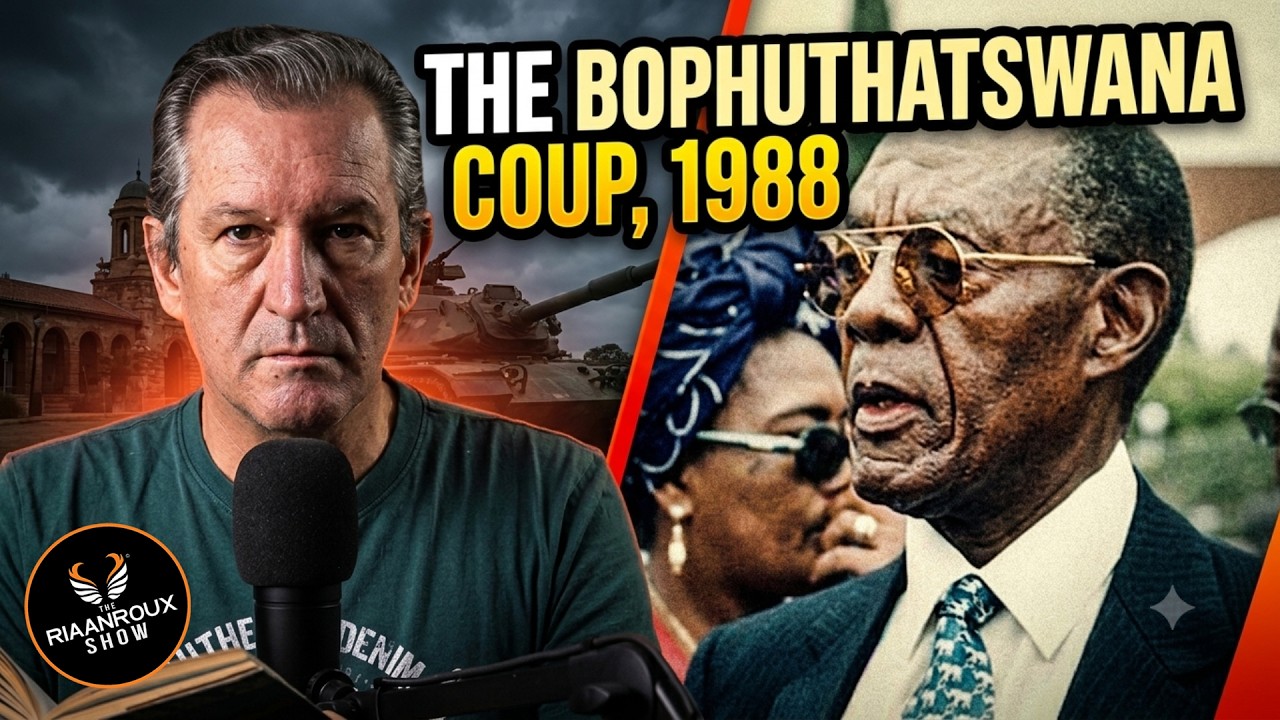
On the morning of 10 February 1988, Bophuthatswana had a new government. A young officer of the Bophuthatswana Defence Force, Rocky Malebane-Metsing, had arrested President Lucas Mangope overnight, and the homeland’s radio was announcing a change of power.
By that evening, South African Defence Force units had crossed the border, retaken the government buildings and restored Mangope to office. The whole reversal took less than 24 hours, required no reference to international law and drew nothing beyond routine condemnation abroad.
That day is the sharpest single answer to a question South Africans rarely ask about the homelands era. The 4 nominally independent bantustans all had armies. Whose armies were they?
The question runs through Fragmented Nations: A History of the Bantustans, the narrative history by Pretoria-based author Liam Richard May published under the Volkskild imprint, and the subject of the second video in my series on the book. The documentary answer May assembles is unambiguous, and it starts in the Transkei.
The Transkei Defence Force was created by the Transkei Defence Act of 1976, in the homeland that took independence first. Its founding battalion was trained at Lenz, an SADF base outside Johannesburg, on South African equipment and doctrine. Its first commander, Major-General Wilhelm Hartzenberg, was a South African officer seconded to the post, and a Transkeian-born commander, Bantu Holomisa, only took over in 1985, 9 years into the force’s existence. Capital spending on its equipment was funded through additional grants from the South African Defence budget.
The template was copied. Bophuthatswana’s force, established in 1977, was consuming roughly R80 million a year by the mid-1980s, about 12% of the entire homeland budget, spent on a military with no external enemy to fight. Venda’s force, in the book’s account, never fought an external engagement in its existence, serving instead for ceremony and for backing the police against internal unrest.
The Ciskei took the pattern somewhere darker. Its security apparatus was, in proportion to population, the largest of any homeland, and command of it ran through a single family, with the president’s brother heading intelligence and the president’s son commanding the special forces. From the early 1980s, the book records, Israeli private security contractors trained those forces and protected the family, with between 40 and 70 Israeli personnel working inside the Ciskei apparatus by the middle of the decade, paid partly through funds whose South African origins, in the book’s careful phrasing, were not always made clear.
The armies could not defend their states, as 1988 proved. What the record shows instead is where the capacity went. In 1986 the SADF trained an Inkatha-aligned paramilitary group at a facility near the Caprivi Strip, part of the covert programme the record knows as Operation Marion, through which the security establishment supported Inkatha-aligned formations against the ANC. Military capacity built under homeland cover was turned inward, into a conflict that killed more South Africans than any other political violence of the late apartheid period.
The ending came in March 1994, weeks before the election, when Bophuthatswana’s civil servants went on strike over pensions and reincorporation, the protests spread, and large sections of the Bophuthatswana Defence Force refused orders to suppress them. The army built to defend Mangope’s government stood down, and the government collapsed in days. That April, all 4 homeland forces were absorbed into the new South African National Defence Force, alongside the SADF that had built them and the MK and APLA fighters they had been positioned against.
The lesson the record leaves behind reaches well past 1994. A security force answers to whoever pays it and appoints its commanders, and everything else, the flag, the anthem and the constitutional language, is presentation. The homeland armies looked like national institutions and functioned as extensions of a patron, and when the patron withdrew, they fell over. The test that history offers applies to any security institution in any era: ask who pays, and ask who appoints.
Fragmented Nations is available in full as a free PDF, with the link and the author’s contact details in the video description. Every passage shown on screen in the video carries its page number, so the record can be checked directly.
An army that could not survive a single day against its own paymaster was never an army. It was a budget line with a flag.
Fragmented Nations: A History of the Bantustans by Liam Richard May, published under the Volkskild imprint.
The full book is available as a free PDF at the link below, and the author’s contact details are included so you can weigh the evidence yourself.
Free PDF of Fragmented Nations: https://drive.google.com/file/d/19NFEN7pZ5yXt_XOy5RjqbiWdB-k2WIL5/view?usp=drivesdk
Author contact and Volkskild channels: Facebook: https://www.facebook.com/share/18MxmMpbr3/
Website: https://www.lrmay.com/
WhatsApp Channel: https://whatsapp.com/channel/0029VbD1aGGL2ATuKfS6kI3e
Instagram: https://www.instagram.com/volkskild