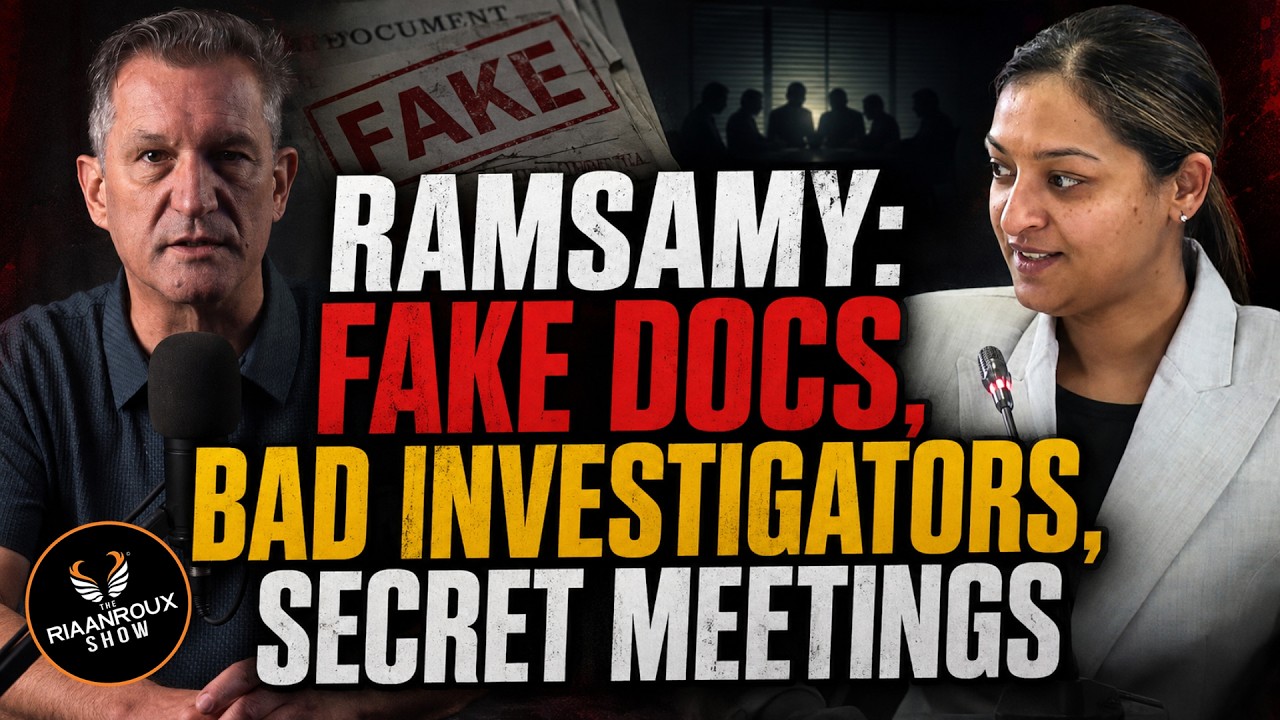
Feroz Khan: Shot Before He Could Talk!
Feroz Khan, the suspended Deputy Head of Crime Intelligence, was shot in Houghton on Sunday night, 48 hours before he was due to testify at the Madlanga Commission of Inquiry. His laptop and phone were taken at the scene, and his lawyers had been finalising his affidavit just hours before the attack. This video goes beyond the shooting itself, examining the device question the mainstream coverage is underplaying, the full timeline leading up to the attack, and what the pattern of witness threats tells us about the commission’s ability to deliver credible findings by its August 2026 deadline.
Major-General Feroz Khan, the suspended Deputy Head of Crime Intelligence, was shot on the night of Sunday 28 June 2026 on 3rd Avenue in Houghton, Johannesburg, close to his home. 2 gunmen in a white Mercedes-Benz opened fire on his vehicle at approximately 11pm. 2 shots were fired. Both hit their target.
Khan was rushed to Netcare Milpark Hospital where he underwent emergency surgery. At the time of publication he remained in a critical but stable condition. He survived.
According to EWN, whose reporters arrived at the scene shortly after the shooting, Khan’s grey Suzuki Baleno was still idling in the road with its headlights on. 2 spent 9mm cartridges were visible beside the vehicle, with ballistics analysts placing yellow markers at the scene. That detail was subsequently corroborated by The Citizen and photographic evidence from the scene.
“A robbery takes the car and takes the wallet. This took the data.”
What distinguishes this shooting from an ordinary violent crime is what was missing when Khan arrived at hospital. According to reports from the scene, Khan raised concerns about 2 devices that were taken during the attack: his laptop and his phone. Those devices contained material directly relevant to his scheduled testimony before the Madlanga Commission of Inquiry, set for Wednesday 1 July, just 48 hours after the attack.
The Timeline
Khan’s legal team had been working with him for 6 weeks preparing his commission testimony. His lawyers confirmed they were with him on Sunday evening, finalising his affidavit. Over that weekend alone they had received over 11,000 pages of disclosure material from the commission and had been working through nights to prepare.
Khan left his lawyers’ offices. Minutes later, they received a call informing them he had been shot.
Investigators will note the sequence: a witness shot 48 hours before a high-stakes appearance, his lawyers the last people to see him, commission disclosure material on devices now missing from the scene.
The Investigation
SAPS Acting National Commissioner Lieutenant-General Puleng Dimpane directed that the Gauteng Hawks, Gauteng Crime Intelligence, the SAPS Detective Service, and the Political Killings Task Team all be deployed to the investigation. The deployment of the PKTT, a unit that specialises in hits connected to organised crime and politically sensitive cases, signals the seriousness with which SAPS is treating the incident.
SAPS spokesperson Brigadier Athlenda Mathe said it would be “premature and irresponsible to speculate on any possible motive” and that investigators would follow the evidence wherever it leads. She also stated that SAPS views any attempt to silence or intimidate anyone involved in the judicial process in the most serious light.
The language and the actions are pointing in different directions.
Who Is Feroz Khan
Khan served as Deputy Head of Crime Intelligence before his suspension. He has been implicated in a wide range of corruption allegations currently before the Madlanga Commission, including interference in criminal investigations, links to organised crime figures, connections to the illicit tobacco trade, the 2021 Aeroton drug bust, and allegations involving illicit precious metals. He was arrested in May 2026 and faces criminal charges at the Kempton Park Magistrate Court.
Central to the commission’s evidence against Khan are WhatsApp exchanges between Khan, EFF leader Julius Malema, and businessman Mohammadh Sayed, who is linked to tobacco company Carnilinx. Those messages were extracted from Khan’s phone during his arrest and were to be the subject of questioning when he testified on Wednesday.
Vusimuzi “Cat” Matlala, the businessman at the centre of the R360 million Medicare24 SAPS tender fraud, has been directly linked to Khan in testimony before the commission. Khan had spent months contesting his appearance in court, challenging both the seizure of his devices and the terms of his testimony. In the end, through his lawyers, he confirmed he would attend on 1 July.
He never got there. The commission’s final report is due by 31 August 2026.
The Counter-Narrative
A complication exists that any honest account of this story must acknowledge. A previous Madlanga Commission witness, Brown Mogotsi, currently faces criminal charges after investigators concluded he staged his own assassination attempt while connected to commission proceedings. That precedent is in the public record and has been raised in connection with Khan on social media and in media commentary.
Questions have also been raised about why Khan, who is reportedly associated with luxury vehicles, was travelling in a modest silver Suzuki Baleno on the night of the attack.
These theories cannot be dismissed, but they also do not resolve the central evidentiary question: the devices were taken. If the attack was staged, the commission’s copy of the disclosure materials sent to Khan’s lawyers creates a documentary record. Any gap between what the commission holds and what was on Khan’s missing devices becomes evidence in itself. The PKTT will be examining all of this.
The Institutional Failure
The shooting of a key commission witness days before his testimony is not an isolated incident. It is part of a pattern.
Businessman Suliman Carrim applied to testify in camera before the Madlanga Commission after receiving death threats directed at himself, his family and his business. Other witnesses have made similar applications. The commission is uncovering something significant enough that people connected to it face threats, whether real or manufactured.
The commission has become a pressure system as much as a legal process. The government overseeing it has not publicly answered whether witnesses appearing before it to testify about corruption inside SAPS are actually safe enough to do so. That question now hangs over every piece of testimony the commission has yet to receive.
A commission that cannot protect its witnesses before they testify cannot guarantee the integrity of the testimony it eventually receives.